

Prison Talk
A Book, an Essay and a Short Story

Welcome to Everything Essay! where I feature an essay (linked) and a theme. I review the art and craft at work in the essay and connect it to other readings, book recs, writing tips, prompts, podcasts, movies and more. Sometimes I talk about a book I’ve read and what I learned about writing from it. Today I’m sharing a book, an essay, and a short story, which all center around the topic of incarceration.
In one of my first posts here (back in July 2025) I reviewed the essay Reading Behind Bars and Beyond Barriers by Jackie Snow. She talked about her experience volunteering with a books-to-prison nonprofit in the DC-area. Since then I’ve been volunteering for the Prisoners Literature Project based in Berkeley, CA. Once a month, I spend a few hours responding to written requests for books from incarcerated people. I cull through the grass-roots organization’s “library” of donated books to make the best match for the ask, with a max of three books and under three pounds. It’s satisfying work.
My interest in prison life and books goes back a long way. In the early 2000’s, I was living in the Chicago area, and I volunteered with Aunt Mary’s Storybook Project, a nonprofit that connects incarcerated parents with their children through books. We visited a women’s prison and brought children’s and YA books. Selected residents could choose a book, read a passage, and share a message with their child, which we recorded on a cassette tape (yes, remember those). And we’d package and mail the books and tapes to the children. Unfortunately, not long after I started to volunteer, the Illinois governor restricted access to Aunt Mary’s Storybook and many other ministries and prison-volunteer programs throughout the state.
Since that experience, I’ve had an interest in prions life and access to books. While I have opinions about what happened back in Illinois and what’s going on in our prisons and penal system today—this isn’t a political blog, it’s about essays and books and reading. So onward to what I’ve been reading lately.
The Book
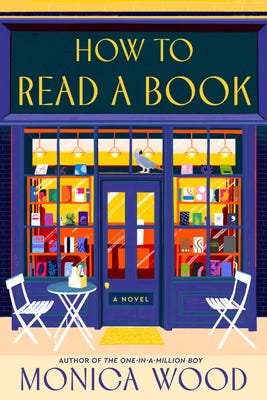
How to Read a Book is a novel by Monica Wood, which tells the story of 22-year-old Violet who is released from prison after serving two years for a driving while intoxicated and hitting and killing a retired kindergarten teacher, a felony-offense. More of a character-driven story than a literary read, I appreciated how the author showed the challenges the formerly incarcerated face as they reintegrate to society—how difficult it is to find a job, a safe space to live, new friends. I also appreciate learning something new from a book, and Woods introduced me to the extraordinary intelligence of the gray parrot and their remarkable linguistic talents and problem-solving skills. (Violet ends ups working for a Russian bird-scientist who specializes in gray parrot research—yes, only happens in a novel.) But there’s a metaphor buried in this subplot, which explores the themes of healing, empathy, and self-discovery, and sets the stage for a transformative moment. While the story relies on a few very convenient coincidences, like Violet running into the deceased kindergarten teacher’s widow in the local bookstore, overall it’s a enjoyable, easy read that also addresses issues surrounding the prison system, particularly re-entry.

The Essay
Can We Still See the Good? by Andrew D. Kaufman shares an experience that he and his college-students have when they study Russian literature alongside incarcerated youth. (The educational program, that Andrew founded, is called Books Behind Bars.) Kaufman sets the story: All semester, I’d encouraged my students to look beyond the barbed wire and state-issued polos. I’d asked them to resist flattening people into their worst acts. And they had.
During the last class session back on the university campus, however, one student admits to discovering that one of the incarcerated students that she’d really connected with was in prison for a serious, violent crime. The group goes silent as they try to process this information, and Kaufman goes on to explore how he and students deal with the questions: What do we do with the whole truth? When the truth hurts? Kaufman talks about moral attention, balancing accountability and compassion, and the complexity and contradictions of the human being. I don’t know how Kaufman’s Substack found its way into my feed, that’s one the mysteries of Substack that I’m still trying to unravel. But I found this to be a compelling essay (1,000 words, a 4-minute read), and now I’m a subscriber.
The Short Story
A Prisoner’s Dream by Karen Kao, recently published on her Substack Swimming Upside Down (one of my favs!), is a marvelous short story (1,471 words, a 6 minute read) with great writing craft and a superb twist. Don’t worry I won’t spoil it for you.
The Premise:
Song, a Chinese prisoner of war during WW II (it seems), recalls and revisits his girlfriend, Helen, a beautiful, pale-skinned, twenty-three-year old from Ames, Iowa through his nightly dreams. The couple dance through the barracks as the other prisoners sleep, climb onto the trash heap for an intimate chat, and then move on to dance again before Helen departs.
The Craft
Scene based, present tense, loads of sensory details.
Kao tells the couples’ story in scene with lots of active verbs and occasional dialogue , weaving in backstory sparingly. She uses lots of sensory details, which enhance her scene-making and the reading experience
Verbs: Song dips; Helen laughs. Song steers; Helen wrinkles her lips, her tongue creeps. Song searches; Helen pouts. Song asks; Helen smiles. They rock and step, zig and zag. They chew and chew and chew. Nostril flare. + many more examples.
Dialogue: Dance with me. Hush, don’t wake the other prisoners.Did you know that butterflies taste with their feet? The least you could do is exert yourself.
Tense. Except in the backstory, Kao uses the present tense, which makes the story feel immediate, as if Song’s dreams are unfolding before the readers’ eyes in real time.
Sensory details: hair as fine as Iowa silk (simile); the hint of blue blood under the surface of her chalk white skin (hints at metaphor); his cracked, dirt-lined palm; the stench of open mouths offends; the ashes and smoke of the dead; a peach flush with dew or an ember before it dies; feed him words by hand like seeds to a songbird (simile); one manicured fingernail; Song’s naked arm; a pock-faced guard. +++ more.
The story’s twist is what’s most revelatory to me. Again, I don’t want to spoil it, but please do let me know what you think about that twist! And comment on anything you’ve read here—I’d love to hear from you.
Free Meet Up
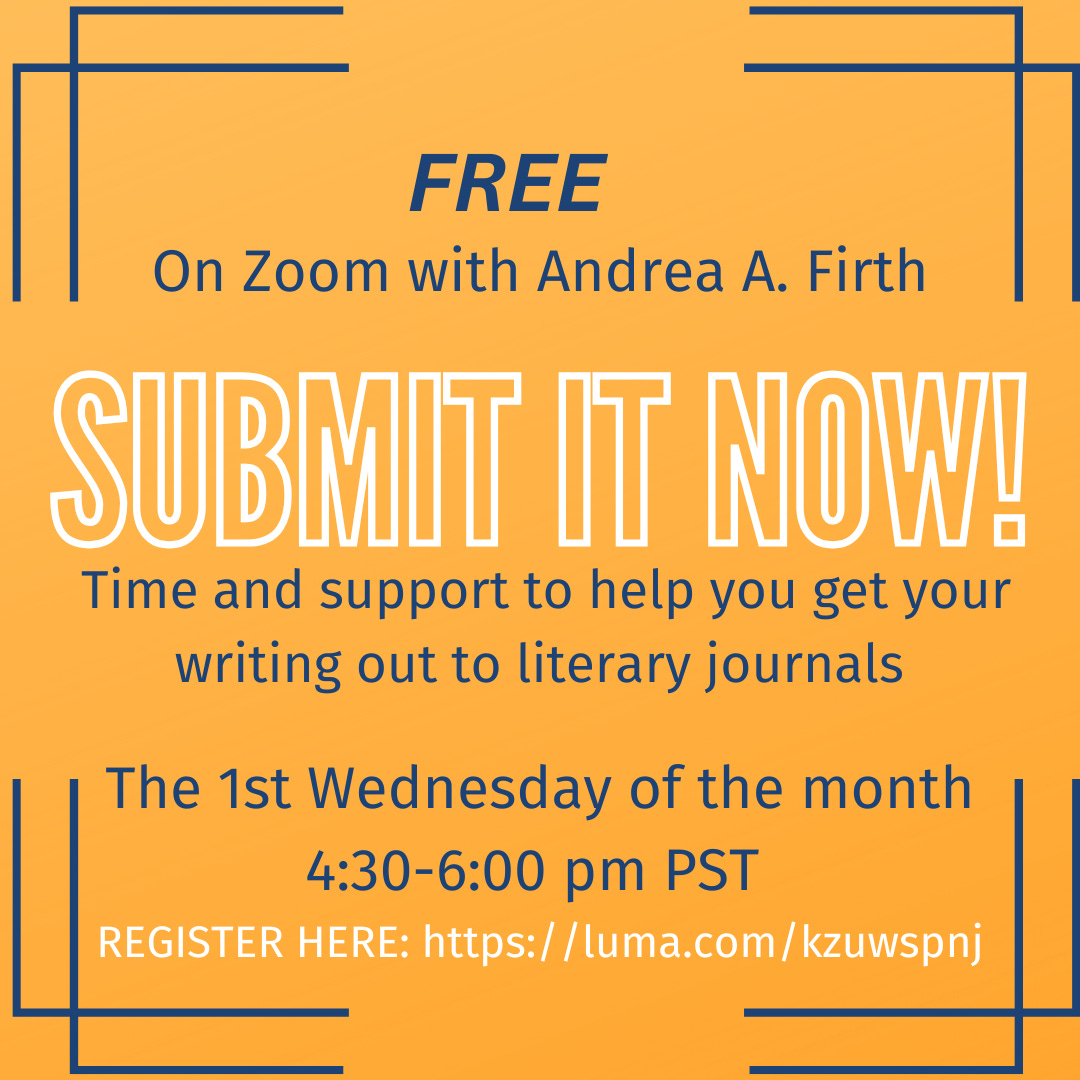
Join me on Zoom this Wednesday, February 4th for Submit It Now! Time and support to submit to lit mags—and get your questions answered. Ask Me Anything. Free! RSVP here for the link.
I’ve been teaching classes in prison off and on since 2011 through Wesleyan University’s Center for Prison Education. It’s been the greatest teaching experience of my life and one of the greatest experiences of my life overall. And I’m old. It’s equal parts exhilarating and heartbreaking. The waste. The cruelty. The joy of being with people who love learning as much as you do. Thanks for this post.
As the mother of an incarcerated man, THANK YOU!!